California employers face a steady stream of HR requirements, regulations and changing rules and it can be difficult to separate what’s actually required from what’s simply become common practice.
Recently, Coastal Payroll presented a live webinar focused on some of the most common HR compliance misconceptions employers encounter. The conversation explored where businesses may be taking on unnecessary risk, what California employers need to know, and how to stay ahead of requirements that can have a real impact on the workplace.
If any of these sound familiar, you’re in good company:
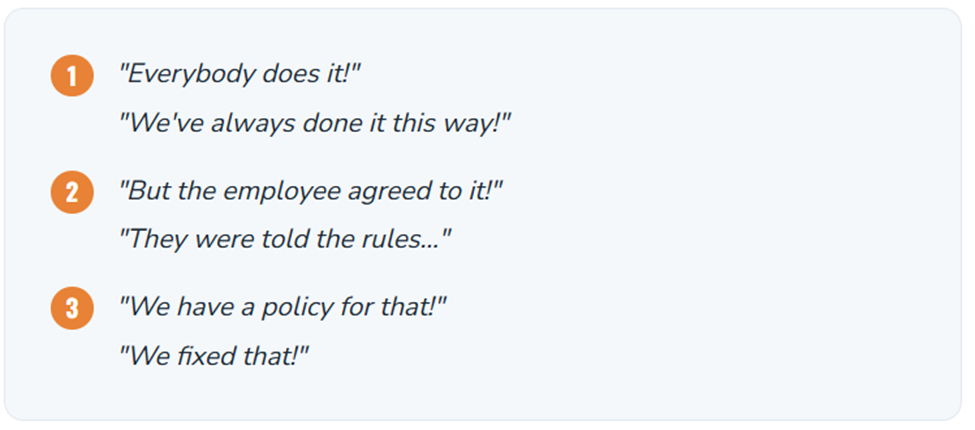
Each of these may sound like a reasonable defense, but in California, a common practice is not always a compliant one. Employee agreement, long-standing habits and even a well-written policy do not automatically mean your business is covered.
Below, we’re breaking down the myths, best practices and true legal mandates across three areas that commonly create confusion: leave and termination, timekeeping and wage and hour, and workplace policies.
What actually counts as a termination, when leave protections kick in, and what you owe employees on the way out.
“We have a 90-day probationary period, so we can term them without risk because they aren’t even employees until they make it through that.”

“We are laying him off, not terminating him. If we eliminate the position (or department), there is no risk.”

“Maternity leave is six (6) weeks for a regular birth and eight (8) weeks for a C-Section.”

“If the employee agrees to it, we can give them their final paycheck when we run the next scheduled payroll.”

Miss the window, and the penalty is steep: one full day of pay for every day final pay is late, capped at 30 days — but that cap can still add up to a very expensive mistake.
How time gets tracked, who’s on the hook when it’s tracked wrong, and what “worked time” really means.
“The practice of managing timecard input — aka ‘Synthetic Timekeeping’ — puts an employer at significant risk of violating the California Labor Code.”

“Employers beware” the following with employee timecards:
“Non-exempt employees must be paid for every second they work — even when they’re doing so voluntarily.”

“We have employees approve their timecards, so we’re protected if the hours are wrong.”

The following are helpful, but not a full shield:
However, all hours worked must still be paid — an approved timecard doesn’t erase an employer’s obligation if the hours recorded were wrong.
Where handbooks, acknowledgements, and time-off policies actually protect you — and where they don’t.
“If a policy is in the employee handbook and the employee signed an acknowledgement, we are protected.”

Signed acknowledgements can definitely help. Here’s when they don’t:
Bottom line: make sure your employee handbook is updated at minimum annually.
“Vacation time and Paid Time Off (PTO) are NOT interchangeable.”

“We have an unlimited PTO/Vacation policy, so we’re not subject to all of those rules!”

Employers with unlimited PTO or vacation policies will definitely be under more scrutiny than those with standard policies. Be ready to answer:
The common thread across all ten? Good intentions and “the way we’ve always done it” don’t always match what California law actually requires. Before relying on a long-standing practice, it’s worth knowing whether it’s a best practice, a myth or a true legal mandate, because getting it wrong can come with real consequences.
Not sure where your current practices fall? Coastal Payroll’s HR Elite gives you access to experienced HR guidance when questions come up, helping you separate fact from HR fiction and make more confident decisions for your business.